
Meet the Congressional Problem Solvers Caucus
ProTip: Call Them the Larry Hogan Wing of Congress

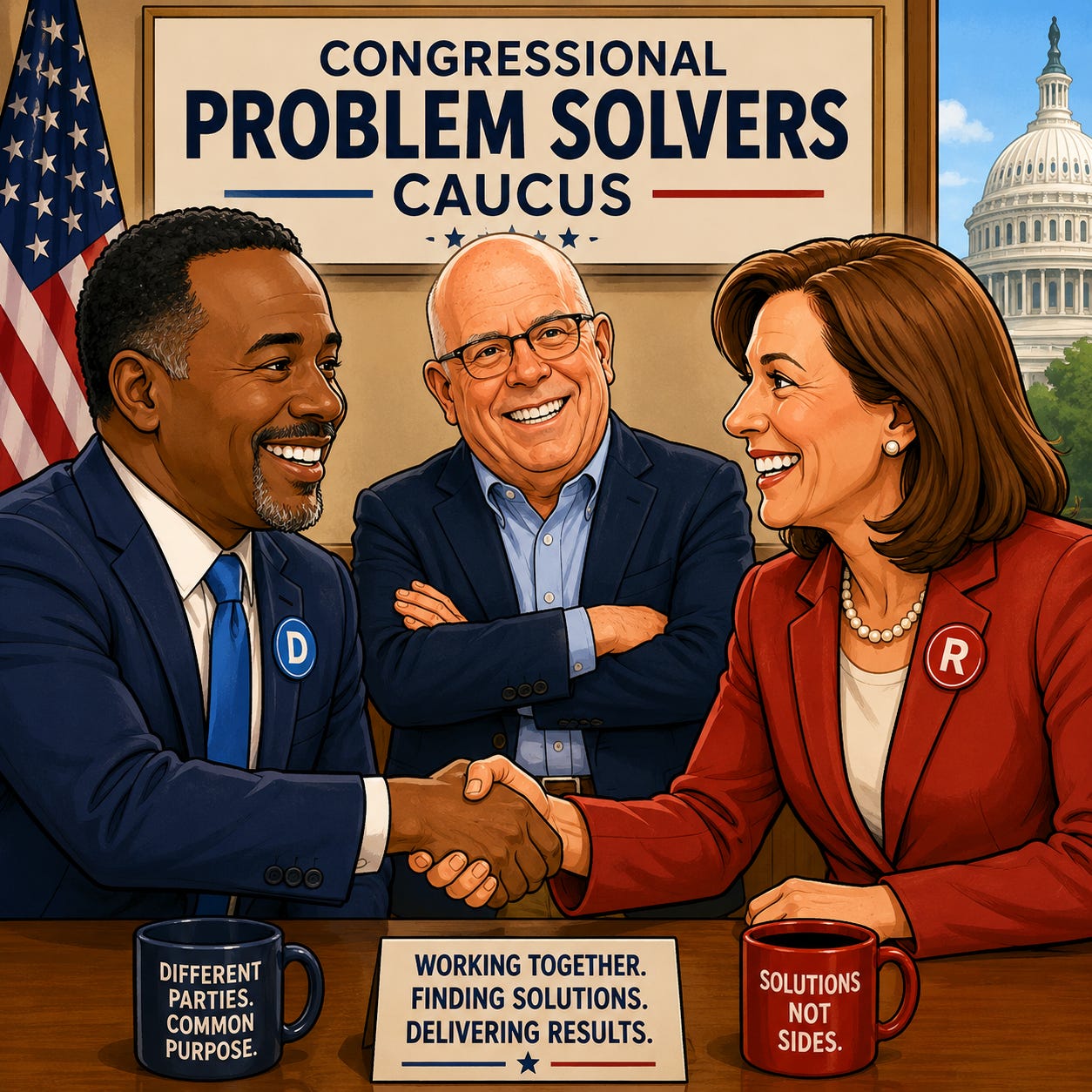
Washington is full of caucuses. Some exist to make speeches. Some exist to raise money. Some exist to fight with the other party.
And then there is the Congressional Problem Solvers Caucus.
The concept is almost radical by modern standards. Republicans and Democrats voluntarily sit in the same room and try to solve problems.
The caucus is evenly divided between Republicans and Democrats. Members meet regularly, debate issues, and seek areas of agreement before legislation reaches the House floor. Unlike most congressional factions, nothing advances without substantial support from both sides. The group’s internal rules require broad bipartisan backing before it endorses legislation. Each endorsement requires support from 75 percent of the Caucus membership, including at least 50 percent of both Democrats and Republicans. This Congress, five PSC-endorsed bills were signed into law, eight passed the House, and an additional three received committee consideration.
That may not sound revolutionary.
In today’s Congress, it is.
The easiest way to understand the Problem Solvers Caucus is to compare it with the better-known Freedom Caucus.
The Freedom Caucus is primarily concerned with pulling Republicans toward a more conservative position. Its battles are often fought inside the Republican Party itself. The caucus has helped bring down House speakers, block Republican leadership initiatives, and force internal confrontations over spending and policy.
The Problem Solvers Caucus takes the opposite approach.
Instead of fighting fellow Republicans or fellow Democrats, its members spend most of their energy finding votes across the aisle. Their theory is simple: in a closely divided country, durable legislation usually requires bipartisan support.
One group asks, “How do we stop this bill?”
The other asks, “How do we get this bill passed?”
You may agree or disagree with the results. But the mission is different.
And the caucus has not been idle.
During the last Congress, the Problem Solvers Caucus endorsed 30 bipartisan bills covering immigration, border security, public safety, child care, and other issues. The caucus also played a role in negotiations that helped prevent a government shutdown and contributed to the debt-ceiling agreement that avoided a potentially severe fiscal crisis.
Earlier, it was heavily involved in the bipartisan infrastructure package and the CHIPS and Science Act.
Today, the group is working on issues that voters routinely tell pollsters they care about: affordability, housing costs, health care expenses, child care, immigration reform, election redistricting, and border security. Recent caucus initiatives have included a bipartisan affordability agenda, support for immigration reform proposals, and efforts to address partisan gerrymandering.
Marylanders should recognize the model immediately. Think of the Problem Solvers Caucus as the Larry Hogan Caucus.
Larry Hogan was never a moderate because he abandoned Republican principles. He was a Republican governor operating in a state where Democrats held overwhelming control of the legislature. If he wanted to accomplish anything, he had to negotiate.
Sometimes that frustrated conservatives.
Sometimes it frustrated liberals.
And it turns out that even in deep Blue Maryland, the approach works.
By the time Hogan left office, he was one of the most popular governors in America. A Washington Post poll in October 2022 found 73 percent approval among Maryland voters, including strong support from Democrats and independents. That kind of approval rating is almost unheard of in modern politics.
The lesson is not that compromise is always good.
Bad compromises exist.
The lesson is that governing requires different skills from campaigning. Campaigns reward ideological purity. Governing requires assembling majorities.
That is what the Problem Solvers Caucus is trying to do.
In an era when political incentives increasingly reward outrage, fundraising emails, and social-media combat, the caucus is betting that some voters still prefer results.
Maybe they are right. Maybe they are wrong.
But in a Congress where everyone claims to be solving problems, the Problem Solvers Caucus is one of the few groups that put the goal right in the name.
Endnotes
Congressional Problem Solvers Caucus, “About the Problem Solvers Caucus.” Available at:
https://problemsolverscaucus.house.gov/aboutCongressional Problem Solvers Caucus, “Problem Solvers Caucus Releases Bipartisan Affordability Agenda.” Available at:
https://problemsolverscaucus.house.gov/media/press-releases/problem-solvers-caucus-releases-bipartisan-affordability-agendaCongressional Problem Solvers Caucus, “Problem Solvers Caucus Endorses the Dignity Act.” Available at:
https://problemsolverscaucus.house.gov/media/press-releases/problem-solvers-caucus-endorses-the-dignity-actCongressional Problem Solvers Caucus, “Problem Solvers Caucus Announces New Gerrymandering Working Group.” Available at:
https://problemsolverscaucus.house.gov/media/press-releases/problem-solvers-caucus-announces-new-gerrymandering-working-group“Problem Solvers Caucus,” Wikipedia, background and historical information on the caucus. Available at:
https://en.wikipedia.org/wiki/Problem_Solvers_CaucusErin Cox and Scott Clement, “Moore Leads Cox by Double Digits in Maryland Governor’s Race, Post-University of Maryland Poll Finds,” The Washington Post, October 1, 2022. Available at:
https://www.washingtonpost.com/dc-md-va/2022/10/01/maryland-poll-moore-cox/