
Defusing the Student Loan Debt Bomb
ProTip: Freshman Year for Free™ is a Model for Cutting College Costs

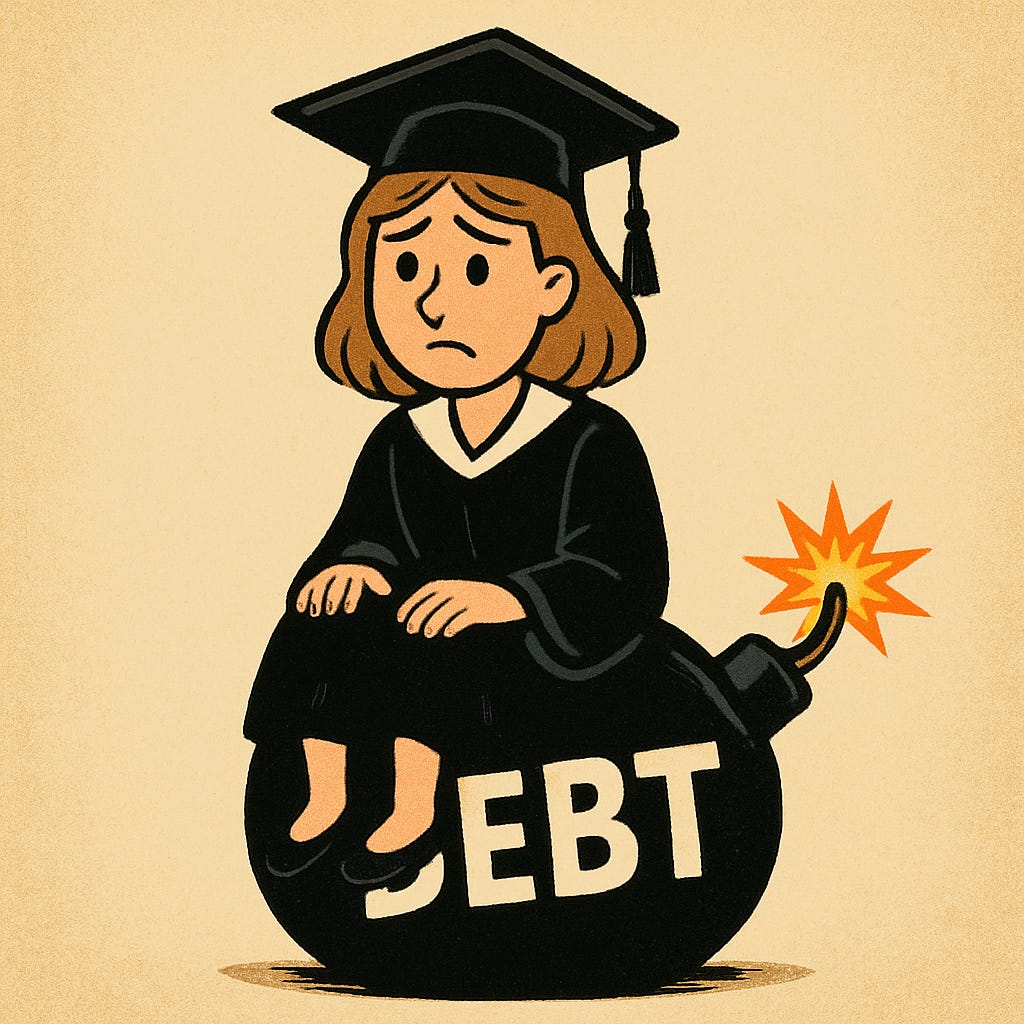
American higher education has become the policy equivalent of a well-meaning uncle who keeps giving you “investment advice” that leaves you owing him money. What began as a noble idea, let every kid chase the American Dream with federally backed student loans, has quietly turned into a $1.8 trillion debt bomb sitting at the base of the country’s social mobility ladder.
And like any good broken policy, this one was assembled by people who meant well. That’s the problem.
Student lending was born out of two great American impulses: the Homestead Act notion that opportunity should be accessible to strivers, and the post-WWII GI Bill, which remains the greatest public investment in human capital ever attempted. That program worked because the mission was simple: educate millions of veterans and make colleges adjust to serve them.
But when Washington tried to recreate the magic with universal student lending, something changed. Instead of schools adapting to serve students, the system evolved so that students and taxpayers adapted to serve schools.
The results speak in numbers large enough to set off a car alarm:
$1.81 trillion in student debt (Q2 2025)
42.3 million Americans carrying it
10% of borrowers now 90+ days delinquent, a spike after payment pauses ended
Debt has more than doubled since 2008
This wasn’t unforeseeable. Eisenhower suspected it in the late 1950s, when colleges demanded twice the loan funding they claimed to need. Education Secretary William Bennett shouted it in a 1987 op-ed, “Our Greedy Colleges:” if you subsidize tuition, colleges will raise tuition. And raise it again. And again.
Washington kept adding oxygen. Colleges kept lighting matches.
Here’s the part the higher-ed lobby would prefer you not dwell on: the single biggest determinant of whether college “pays off” is whether you actually finish it.
Nearly four in ten students who start college never graduate. That’s the country’s largest, least discussed driver of long-term financial instability. And the borrowers hit hardest are the most earnest strivers—the ones sold on college as a golden ticket:
Students who attend pricey private colleges without the prestige premium.
Students who pursue “non-economic” majors that come with minimal, delayed, or nonexistent wage gains.
Students who don’t finish but still owe the debt.
The public gets all this. A new Pew survey finds that 70% of Americans think the higher-ed system is headed in the wrong direction. That’s up from 56% in 2020. Republicans and Democrats both agree—rarely seen, almost anthropologically fascinating.
And they’re not vague about why:
79% say colleges are doing a fair or poor job of keeping tuition affordable.
55% say colleges aren’t preparing students for well-paying jobs.
49% say colleges aren’t even building basic critical-thinking skills.
Less than one-third give colleges high marks on anything besides research.
Imagine running an industry where eight in ten customers think you’re price-gouging and half think your product doesn’t work. Only higher ed could get away with it.
The public’s verdict is clear: if you take federal subsidies for decades while jacking up prices faster than inflation, and deliver declining value, eventually people notice.
Want change? We can do it by changing the cost structure—preferably by bypassing the structure that created the debt machine in the first place. Enter one of the most quietly subversive ideas in American education:
Freshman Year for Free™
Freshman Year for Free™—run by the non-profit Modern States Education Alliance—is simple. It works like this:
Students take high-quality, self-paced, free online courses taught by real university professors.
Courses prepare them for CLEP exams—standardized tests accepted by 2,900+ colleges.
Modern States pays the exam fees and reimburses testing-center costs.
Students earn up to one full year of accredited college credit.
Total tuition cost: $0.
Check it out at https://modernstates.org/
It’s the GI Bill mentality in modern form: scale opportunity, force institutions to adapt, and treat students like customers instead of hostages.
This model cuts the cost of a four-year degree by 25%—before you even talk about scholarships or state aid. It also solves the “risk” problem. If you can complete 30 credits for free, you can learn whether college is right for you before taking on debt.
Freshman Year for Free™ is one path. Apprenticeships, certificates, and skills-driven alternatives are others.
Defusing the student loan bomb won’t come from Congress’s next “relief” package or another subsidy round. It’ll come from giving students faster, cheaper, more flexible ways to prove what they know—and making colleges compete with that.